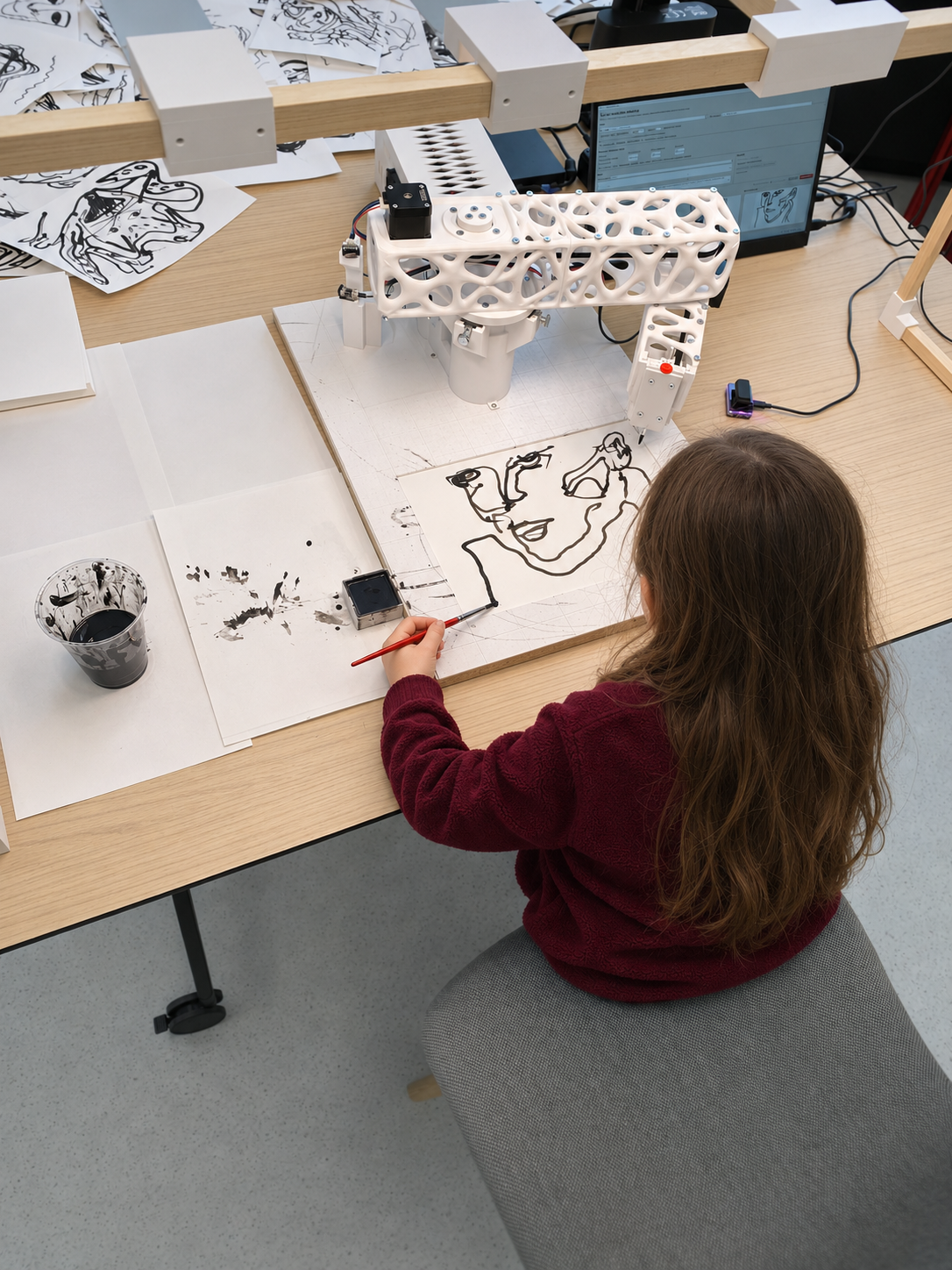
Our Research Associate Alessandro Mac-Nelly presented his research project Embodied AI and Creativity at the Robotic Weeks of the IPAI Foundation in Heilbronn.
With a newly developed Robotic arm and an expanded interactive environment, visitors and the AI-Robot collaboratively create drawings. Taking turns on the same sheet of paper, each new stroke provides additional input for the AI model to generate its next response. Throughout this process, the meaning of previously drawn strokes can continuously shift, as human and machine perception may differ.
The installation serves as a research instrument to investigate creative processes involving AI: To what extent do people respond to the robot’s visual impulses? How do they attempt to influence or steer the system? And how can insights from these interaction dynamics be transferred to other fields of creative collaboration?
It was an exciting week at the IPAI Foundation Visitor Center, with many interesting encounters, conversations, and different perspectives on the work.
The generative AI model is based on Stable Diffusion 1.5, fine-tuned through LoRA training on a dataset of 240 original brush paintings to adapt its visual output to a specific brushstroke aesthetic. In a subsequent step, the generated pixel image is translated into planned brushstroke trajectories, which are then executed by the robotic arm.
Our Research Associate Alessandro Mac-Nelly presented his research project Embodied AI and Creativity at the Robotic Weeks of the IPAI Foundation in Heilbronn.
With a newly developed Robotic arm and an expanded interactive environment, visitors and the AI-Robot collaboratively create drawings. Taking turns on the same sheet of paper, each new stroke provides additional input for the AI model to generate its next response. Throughout this process, the meaning of previously drawn strokes can continuously shift, as human and machine perception may differ.
The installation serves as a research instrument to investigate creative processes involving AI: To what extent do people respond to the robot’s visual impulses? How do they attempt to influence or steer the system? And how can insights from these interaction dynamics be transferred to other fields of creative collaboration?
It was an exciting week at the IPAI Foundation Visitor Center, with many interesting encounters, conversations, and different perspectives on the work.
The generative AI model is based on Stable Diffusion 1.5, fine-tuned through LoRA training on a dataset of 240 original brush paintings to adapt its visual output to a specific brushstroke aesthetic. In a subsequent step, the generated pixel image is translated into planned brushstroke trajectories, which are then executed by the robotic arm.