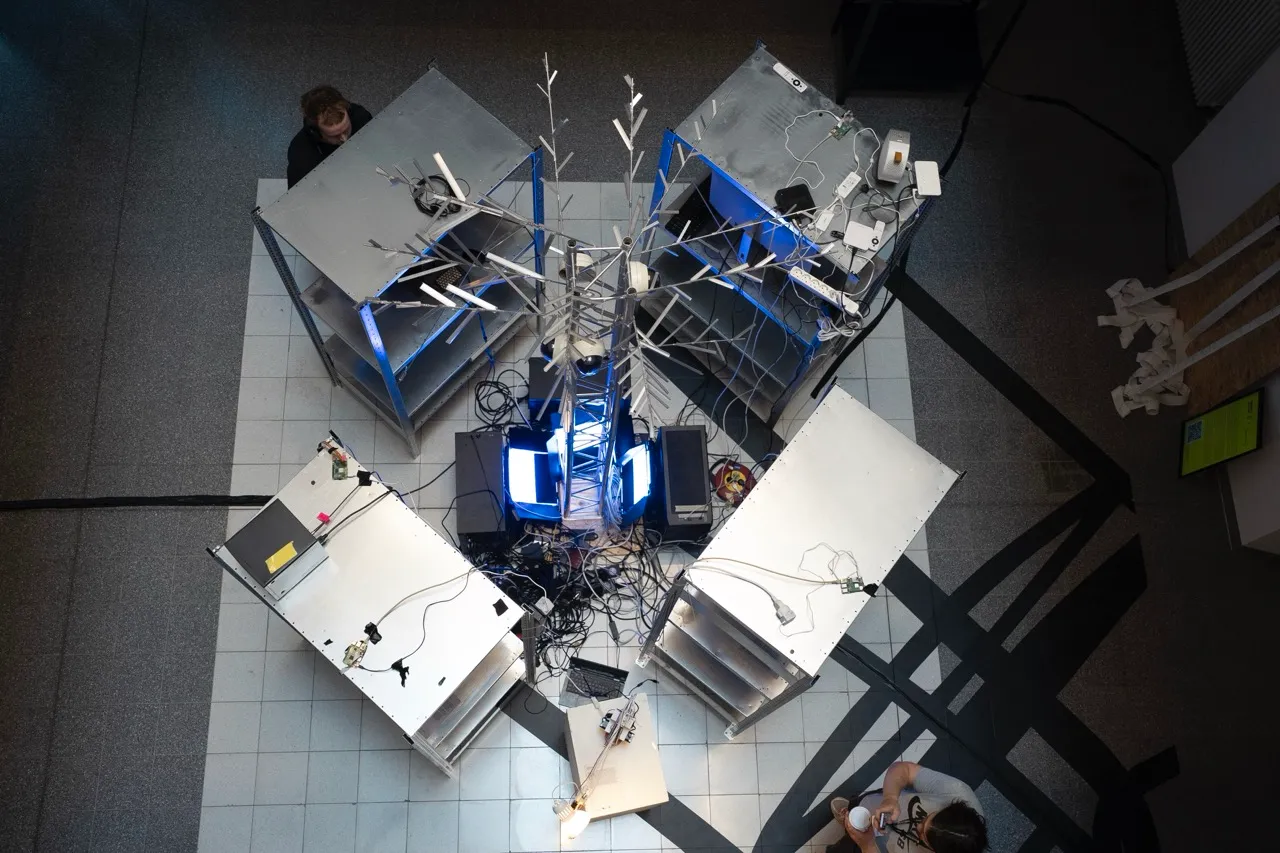
This September, Students of Design and Computation were part of the Campus Exhibition at the Ars Electronica in Linz.
The Ars Electronica is one of the highlights every year; giving us the opportunity to come together and have productive exchanges with all the other international groups. This year's exhibition is called ‘Negative Spaces’ and brings together projects that examine how knowledge is shaped through images, data, and technological systems, all the while questioning what remains unseen in the process. Instead of presenting knowledge as fixed, the works foreground the structures that determine what becomes visible and thus, meaningful. Some of the guiding questions include: what is the invisible architecture of data-harvesting? How is the gaze reconstituted under a state of surveillance? What can archaeological fragments tell us about structures of categorization? Negative Spaces repositions the viewer as an active participant, letting them touch the unseen, influence how narratives unfold, and engage with gaps in datasets and archives, revealing how absence informs understanding just as crucially as presence.